For example, 3D Studio Max, Maya, LightWave, Cinema 4D, Blender, Sketchup, ZBrush etc.
Remember that you are trying to comprehensively explain the theory and applications of 3D with elucidated examples and consistently using subject terminology correctly.
__________________________________________________________________
3D Studio Max:
Auto Desk 3DS Max, formerly known as 3D Studio Max, is a 3D computer graphics program, which allows the user to create high quality animations, models and images. The program itself was created and developed by Auto desk Media and Entertainment. The program can be used on Windows platform and is very flexible, not only it allows for both modelling and animation within the same packet, but it also has a flexible range of plugins to extend the capabilities of the program. The program is used by many professional game developers, animators, modelers and TV studios. The latest version of the program features its own lightning system, customizable interface as well as its very own scripting language.Other important features include flexible user interface, support from the creators as well as features that make the job of a person much easier with things like skinning and texturing tools as well as adaptability with other programs.

Maya:
Auto desk Maya, usually shortened down to simply Maya, created in 1998, is a 3D computer graphics piece of software that originally belonged to a company called Alias System Corporation, the program later on in its lifetime was bought by the Auto Desk company who already own programs like 3DS Max. Maya allows users to do quite similar tasks to those of 3DS Max however in a quite different form. While 3DS Max, with its scripting language and additional tools exceeds at being a great tool for the creation of video game assets, Maya is more useful for the movie industry, to create entire movies in it or just special effects. Films like Finding Nemo, Up and Monsters Inc. Have all been created within Maya, popular TV shows like The Walking Dead and The Game of Thrones also use Maya for their special effects which ease the production greatly. That does not mean however that Maya isn't used in video game industry, it is still used to great extents in areas like animations and details on particular assets. The program operates on 3 different languages, C++, MEL and Python, the word itself, Maya, comes from the Sanskrit word Maya (माया māyā), the Hindu concept of illusion.

Light Wave:
Light Wave is a high performance 3D computer graphics software that is constantly being developed by NewTek ever since 1988 when the first versions of what would become Light Wave started to form. The program is being used in a lot of different industries, this include the movie industry, game developing, TV broadcasts, motion graphics, commercial, visual effects, product design, architectural work, virtual productions, music video production, pre-visualisations as well as many more. The program can be run on both Mac and Windows operating system and is well known for its very fast photo realistic renderer, Light Wave is regarded as a great tool for a rapid 3D development and is used widely by indie developers and freelance artists. For this reason Light Wave is also used in low budget productions and in TV shows with tight schedule. The engine of Light Wave allows for rendering both static and animated 3D models as well as supports many scripting languages, including C++ and as of version 11, Python.

Light Wave itself is built in 2 different parts (programs) that cooperate with each other very closely. The first one is called Modeler, it allows the artist to create a model or load an existing one and edit it, Modeler has many features that allow the artist to do whatever he pleases with the model, including adding new things to it with either primitives or more advanced polygonal modeling, editing the model by doing things like stretching, moving and resizing or do more advanced things like focus on individual constructs and points of a model. Modeler is very good because it is really easy to use but hard to master which allows for even beginners to start using it right away. The second part of Light Wave is called Layout and it is where an artist would take his finished model from modeler, from here, an artist can animate the object, add surfaces, edit it some more as well as render the object as a finished product. Similarly to modeler, layout is easy to learn but hard to master. There is a third program called The Hub which connects the two programs together, allowing for easy synchronization of data as well as for easy transfer of files and assets.

Light Wave keeps up with its competitors even after such long time, with constant updates the program can support everything, from basic models to advanced reflections, refractions, radiosity, caustics and 999 free cross-platform render nodes. Artists can also expand the possibilities within Light Wave by installing additional plugins.
Blender:
Blender, originally released in 1995 is a 3D computer graphics software that is used to create animated films, visual effects, art, 3D printed models, interactive 3D applications and video games. Blender's features include 3D modeling, UV unwrapping, texturing, rigging and skinning, fluid and smoke simulation, particle simulation, soft body simulation, sculpting, animating, match moving, camera tracking, rendering, video editing and compositing. It also features a built-in game engine. Blender originally was a shareware (limited program to others that had to be licensed first and not be used for commercial uses) until 2002 when the company that created and managed the program, Not a Number Technologies (NaN) went bankrupt and wanted to abandon the piece of software all together. Luckily for Blender, NaN made an offer to sell the program to whoever would pay €100,000 (US$100,670 at the time).
 The internet community quickly created a fund-raise and managed to fund raise the money via donation system, then acquired Blender and made it free and open source which are the strongest points of this software to this day, no other 3D applications is cheap, and certainly it isn't free, with Blender, the software is not only free but it also allows the users to create extensions to the software because of its open source (which pretty much means nearly endless possibilities) . This therefore means that Blender is managed completely by its communities and regularly updated. Blender operates in C (core), C++ and Python scripting languages and can be heavily modified to fit anyone needs. It is also available on Linux, Mac and Windows making it one of the more versatile 3D programs to date.
Before Blender went free, the user interface was considered to be one of the most difficult interfaces to learn, simply because it was so very different and uncommon in comparison with its competitors, however, once Blender was taken over by its community, an effort was made to change the interface, interface was redone to be simpler, more common in practice, have color layouts, floating widgets, help tabs and many more which made the program a lot easier to learn for newcomers.

Blender is used by many industries to date, for example, it is a mainstream program to use within archeology for things like reconstruction of facial characteristics of people who lived thousands of years ago.
Blender .blend files are cross-platform, compatible with many different programs and can be both forwarded and backward making the files very versatile.
Even now, there are many indie movies being created by the community within Blender, with their own tools whom they created and published for the world to use.
Cinema 4D:
Cinema 4D is a 3D modelling, animating and rendering application created and developed by MAXON Computer GmbH. The software is capable of procedural and polygonal/subd modeling, as well as animating, creating special effects, lightning, texturing, rendering and other common features that are found in other 3D software's. Four variants are currently available from MAXON: a core CINEMA 4D 'Prime' application, a 'Broadcast' version with additional motion-graphics features, 'Visualize' which adds functions for architectural design and 'Studio', which includes all modules. CINEMA 4D runs on Windows and Macintosh PC's.
Before version 11, Cinema 4D had modular approach towards itself, meaning that a user would need to install the core of the software and then add different modules on top of that as he needed them. This is no longer the case however there are still bits present within various variants of Cinema 4D that are left from this model.
Cinema 4D is used in many industries but very extensively within film industry, Cinema 4D has been used to create films like Pacific Rim and Iron Man 3.
 Z Brush:
Z Brush is a digital sculpting, created in 1999 by a company called Pixologic Inc. Z Brush is a tool that combines together elements of 3D and 2.5D modeling, texturing and painting.
 The primary technology used by Z Brush is called 'pixol' (Like a pixel, each pixol contains information on X and Y position and color values. Additionally, it contains information on depth (or Z position), orientation and material. ZBrush related files store pixol information, but when these maps are exported (e.g., to JPEG or PNG formats) they are flattened and the pixol data is lost) the pixol technology stores pretty much everything, from lightning, through color and depth, ending on information about the model.
Z Brush is a digital tool for creating high definition models that are drawn on the spot within the software (up to ten million polygons), with a range of varied tools available for artists use for his ease. Z Brush uses dynamic levels of resolutions to allow artists to make changes to their already existing models on either a massive or small scale. Z Brush is well known for being able to create a lot of detail on models which previously had to be painted in bump maps. The resulting then meshes can be exported as normal maps with lower polygon count which makes the model simpler to configure and use. The model can also be projected onto a background once it is finished, creating a 2.5D effect rather than 3D. Sometimes artists will compress a model to 2.5D only to work on another 3D model within the same scene which saves a lot of processor power.
Z Brush is available in both Windows and Mac Operating systems and comes with many additional features including things like different brushes for ease of drawing, Polypaint, which allows to paint on a surface within Z Brush and many other Z Brush specific addons that make Z Brush one of the most reliable digital sculpting tools.
Sketchup:
Sketchup is another sculpting program that is mainly used for things like product design, architectural work, interior design, civil and mechanical engineering as well as film and video game designs. The program was created in 2000 and is developed and owned by Trimble Navigation. Before them Google owned the program from 2006 to 2012 and before them, the program was an independent piece of software.
Sketchup is available in 2 version, one free one called SketchUp Make and another one, the paid one, called SketchUp Pro.

The program is easy to use, with free assets that are available to be downloaded from the internet (things like walls, windows, textures etc.), the program also includes things like drawing layout functionality, allows surface rendering in various styles and also supports third party plug ins which expands the software greatly, allowing it even to render near photo realistic models. SketchUp models can also be used to be placed on Google Earth.
File Formats:
All 3D applications allow the user to save their work, both objects and scenes, in a proprietary format, and then export them in an open format. A proprietary format is where the file and its contents are considered an individual property (IP) of an individual or an organization, in contrast, an open format is considered something that does not belong to anyone, i.e. its no ones intellectual property (or if a person that held the IP released the claim). Proprietary format can either be open if its published and considered legal, or closed if it threatens the organization that owns the file format. In contrast, an open file format can never be closed.
Proprietary formats are usually controlled by a private person or organization for the benefit of its applications, protected with patents or as trade secrets, and intended to give the license holder exclusive control of the technology to the (current or future) exclusion of others.

Examples of proprietary formats:
-AutoCAD - dxf
-3D Studio Max - .3ds
-Maya - .mb
-LightWave - .lwo
Examples of open formats:
-.obj
-.dae.
Sources:
Written:
3DS Max
Maya
Light Wave
Blender
Cinema 4D
ZBrush
Sketch Up
Pictures:
http://olocoder.ru/UP17.html
http://area.autodesk.com/maya2011/features
http://forums.newtek.com/archive/index.php/t-129193.html
http://www.rap-ing.si/lightwave.2
http://spiritcrisis.deviantart.com/art/Blender-Logo-241073103
http://en.wikibooks.org/wiki/Blender_3D:_Noob_to_Pro/Yafray_Render_Options
http://www.indigorenderer.com/indigo-cinema-4d
http://www.creativetools.se/pixologic-zbrush-4r6-win-academic-license-floating-licence-esd-10
http://www.iceis.pl/sketchup/
http://www.rizwanashraf.com/2010/02/10/download-free-3d-modeling-applications/
Videos:
http://www.youtube.com/watch?v=RJpRyOPBUYE
3D Studio Max:
Auto Desk 3DS Max, formerly known as 3D Studio Max, is a 3D computer graphics program, which allows the user to create high quality animations, models and images. The program itself was created and developed by Auto desk Media and Entertainment. The program can be used on Windows platform and is very flexible, not only it allows for both modelling and animation within the same packet, but it also has a flexible range of plugins to extend the capabilities of the program. The program is used by many professional game developers, animators, modelers and TV studios. The latest version of the program features its own lightning system, customizable interface as well as its very own scripting language.Other important features include flexible user interface, support from the creators as well as features that make the job of a person much easier with things like skinning and texturing tools as well as adaptability with other programs.

Maya:
Auto desk Maya, usually shortened down to simply Maya, created in 1998, is a 3D computer graphics piece of software that originally belonged to a company called Alias System Corporation, the program later on in its lifetime was bought by the Auto Desk company who already own programs like 3DS Max. Maya allows users to do quite similar tasks to those of 3DS Max however in a quite different form. While 3DS Max, with its scripting language and additional tools exceeds at being a great tool for the creation of video game assets, Maya is more useful for the movie industry, to create entire movies in it or just special effects. Films like Finding Nemo, Up and Monsters Inc. Have all been created within Maya, popular TV shows like The Walking Dead and The Game of Thrones also use Maya for their special effects which ease the production greatly. That does not mean however that Maya isn't used in video game industry, it is still used to great extents in areas like animations and details on particular assets. The program operates on 3 different languages, C++, MEL and Python, the word itself, Maya, comes from the Sanskrit word Maya (माया māyā), the Hindu concept of illusion.

Light Wave:
Light Wave is a high performance 3D computer graphics software that is constantly being developed by NewTek ever since 1988 when the first versions of what would become Light Wave started to form. The program is being used in a lot of different industries, this include the movie industry, game developing, TV broadcasts, motion graphics, commercial, visual effects, product design, architectural work, virtual productions, music video production, pre-visualisations as well as many more. The program can be run on both Mac and Windows operating system and is well known for its very fast photo realistic renderer, Light Wave is regarded as a great tool for a rapid 3D development and is used widely by indie developers and freelance artists. For this reason Light Wave is also used in low budget productions and in TV shows with tight schedule. The engine of Light Wave allows for rendering both static and animated 3D models as well as supports many scripting languages, including C++ and as of version 11, Python.

Light Wave itself is built in 2 different parts (programs) that cooperate with each other very closely. The first one is called Modeler, it allows the artist to create a model or load an existing one and edit it, Modeler has many features that allow the artist to do whatever he pleases with the model, including adding new things to it with either primitives or more advanced polygonal modeling, editing the model by doing things like stretching, moving and resizing or do more advanced things like focus on individual constructs and points of a model. Modeler is very good because it is really easy to use but hard to master which allows for even beginners to start using it right away. The second part of Light Wave is called Layout and it is where an artist would take his finished model from modeler, from here, an artist can animate the object, add surfaces, edit it some more as well as render the object as a finished product. Similarly to modeler, layout is easy to learn but hard to master. There is a third program called The Hub which connects the two programs together, allowing for easy synchronization of data as well as for easy transfer of files and assets.

Light Wave keeps up with its competitors even after such long time, with constant updates the program can support everything, from basic models to advanced reflections, refractions, radiosity, caustics and 999 free cross-platform render nodes. Artists can also expand the possibilities within Light Wave by installing additional plugins.
Blender:
Blender, originally released in 1995 is a 3D computer graphics software that is used to create animated films, visual effects, art, 3D printed models, interactive 3D applications and video games. Blender's features include 3D modeling, UV unwrapping, texturing, rigging and skinning, fluid and smoke simulation, particle simulation, soft body simulation, sculpting, animating, match moving, camera tracking, rendering, video editing and compositing. It also features a built-in game engine. Blender originally was a shareware (limited program to others that had to be licensed first and not be used for commercial uses) until 2002 when the company that created and managed the program, Not a Number Technologies (NaN) went bankrupt and wanted to abandon the piece of software all together. Luckily for Blender, NaN made an offer to sell the program to whoever would pay €100,000 (US$100,670 at the time).
Before Blender went free, the user interface was considered to be one of the most difficult interfaces to learn, simply because it was so very different and uncommon in comparison with its competitors, however, once Blender was taken over by its community, an effort was made to change the interface, interface was redone to be simpler, more common in practice, have color layouts, floating widgets, help tabs and many more which made the program a lot easier to learn for newcomers.

Blender is used by many industries to date, for example, it is a mainstream program to use within archeology for things like reconstruction of facial characteristics of people who lived thousands of years ago.
Blender .blend files are cross-platform, compatible with many different programs and can be both forwarded and backward making the files very versatile.
Even now, there are many indie movies being created by the community within Blender, with their own tools whom they created and published for the world to use.
Cinema 4D:
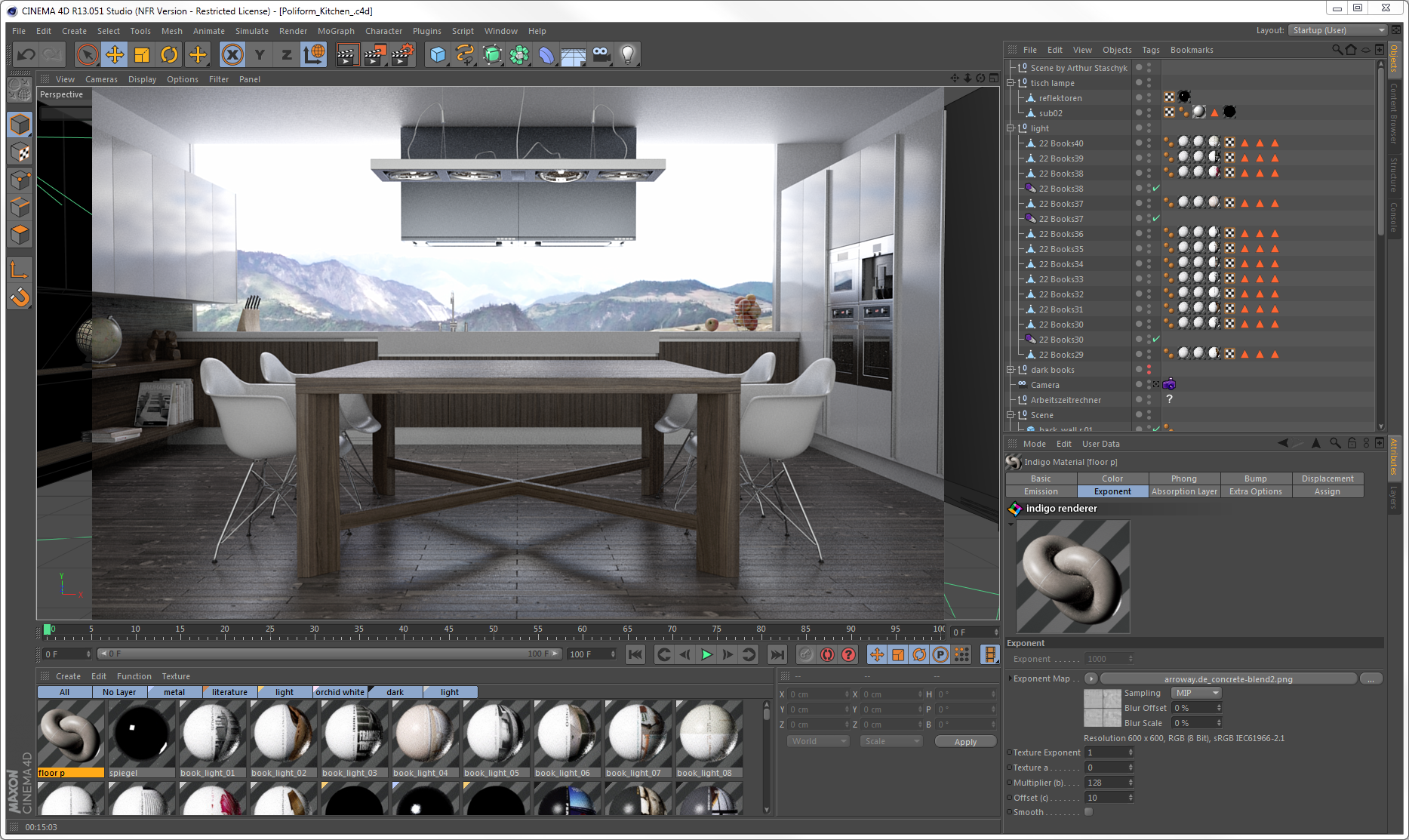
Cinema 4D is a 3D modelling, animating and rendering application created and developed by MAXON Computer GmbH. The software is capable of procedural and polygonal/subd modeling, as well as animating, creating special effects, lightning, texturing, rendering and other common features that are found in other 3D software's. Four variants are currently available from MAXON: a core CINEMA 4D 'Prime' application, a 'Broadcast' version with additional motion-graphics features, 'Visualize' which adds functions for architectural design and 'Studio', which includes all modules. CINEMA 4D runs on Windows and Macintosh PC's.
Before version 11, Cinema 4D had modular approach towards itself, meaning that a user would need to install the core of the software and then add different modules on top of that as he needed them. This is no longer the case however there are still bits present within various variants of Cinema 4D that are left from this model.
Cinema 4D is used in many industries but very extensively within film industry, Cinema 4D has been used to create films like Pacific Rim and Iron Man 3.
Z Brush is a digital sculpting, created in 1999 by a company called Pixologic Inc. Z Brush is a tool that combines together elements of 3D and 2.5D modeling, texturing and painting.

Z Brush is a digital tool for creating high definition models that are drawn on the spot within the software (up to ten million polygons), with a range of varied tools available for artists use for his ease. Z Brush uses dynamic levels of resolutions to allow artists to make changes to their already existing models on either a massive or small scale. Z Brush is well known for being able to create a lot of detail on models which previously had to be painted in bump maps. The resulting then meshes can be exported as normal maps with lower polygon count which makes the model simpler to configure and use. The model can also be projected onto a background once it is finished, creating a 2.5D effect rather than 3D. Sometimes artists will compress a model to 2.5D only to work on another 3D model within the same scene which saves a lot of processor power.
Z Brush is available in both Windows and Mac Operating systems and comes with many additional features including things like different brushes for ease of drawing, Polypaint, which allows to paint on a surface within Z Brush and many other Z Brush specific addons that make Z Brush one of the most reliable digital sculpting tools.
Sketchup:
Sketchup is another sculpting program that is mainly used for things like product design, architectural work, interior design, civil and mechanical engineering as well as film and video game designs. The program was created in 2000 and is developed and owned by Trimble Navigation. Before them Google owned the program from 2006 to 2012 and before them, the program was an independent piece of software.
Sketchup is available in 2 version, one free one called SketchUp Make and another one, the paid one, called SketchUp Pro.

File Formats:
All 3D applications allow the user to save their work, both objects and scenes, in a proprietary format, and then export them in an open format. A proprietary format is where the file and its contents are considered an individual property (IP) of an individual or an organization, in contrast, an open format is considered something that does not belong to anyone, i.e. its no ones intellectual property (or if a person that held the IP released the claim). Proprietary format can either be open if its published and considered legal, or closed if it threatens the organization that owns the file format. In contrast, an open file format can never be closed.
Proprietary formats are usually controlled by a private person or organization for the benefit of its applications, protected with patents or as trade secrets, and intended to give the license holder exclusive control of the technology to the (current or future) exclusion of others.

Examples of proprietary formats:
-AutoCAD - dxf
-3D Studio Max - .3ds
-Maya - .mb
-LightWave - .lwo
Examples of open formats:
-.obj
-.dae.
Sources:
Written:
3DS Max
Maya
Light Wave
Blender
Cinema 4D
ZBrush
Sketch Up
Pictures:
http://olocoder.ru/UP17.html
http://area.autodesk.com/maya2011/features
http://forums.newtek.com/archive/index.php/t-129193.html
http://www.rap-ing.si/lightwave.2
http://spiritcrisis.deviantart.com/art/Blender-Logo-241073103
http://en.wikibooks.org/wiki/Blender_3D:_Noob_to_Pro/Yafray_Render_Options
http://www.indigorenderer.com/indigo-cinema-4d
http://www.creativetools.se/pixologic-zbrush-4r6-win-academic-license-floating-licence-esd-10
http://www.iceis.pl/sketchup/
http://www.rizwanashraf.com/2010/02/10/download-free-3d-modeling-applications/
Videos:
http://www.youtube.com/watch?v=RJpRyOPBUYE